 The best design at the most affordable price
  info@qmwheel.com
  +86 18026941430


 English
  en
en  it
it  es
es  tr
tr  sv
sv  pt
pt  cs
cs  nl
nl  ru
ru  fr
fr  de
de  pl
pl  ar
ar 

The global e-bike industry continues to expand, but customer expectations are changing. Today, buyers are no longer satisfied with attractive designs alone. They want products that can travel farther, perform reliably on different terrains, and require less maintenance over time.
As a result, the demand for the long range fat tire electric bike category has grown significantly across North America, Europe, and emerging outdoor recreation markets. For distributors, retailers, and private-label brands, understanding what actually determines range and durability is essential when selecting products for long-term sales success.
This article explores the key factors behind a reliable long-range fat tire e-bike and what B2B buyers should evaluate before placing orders.
Why Long Range Matters More Than Ever
Range anxiety is not limited to electric cars. E-bike users also care about how far they can travel on a single charge.
Many consumers use fat tire e-bikes for:
Daily commuting
Weekend adventures
Camping trips
Hunting and fishing activities
Beach riding
Mountain and trail exploration
These applications often involve longer riding distances and fewer charging opportunities. A long range fat tire electric bike gives riders greater flexibility and confidence, making it a more attractive product in competitive markets.
For dealers, higher-range models typically command stronger customer interest and better profit margins compared with entry-level products that focus solely on price.
Battery Capacity Is Only Part of the Equation
Many buyers immediately look at battery size when evaluating range. While battery capacity is important, it is only one piece of the puzzle.
A large battery does not automatically guarantee better real-world performance.
Several factors influence actual riding distance:
Motor Efficiency
An efficient motor converts electrical energy into usable power with minimal waste.
Poor motor design can drain batteries quickly, especially when climbing hills or carrying heavier loads.
Controller Optimization
The electronic control system manages power delivery between the battery and motor.
A well-tuned controller helps reduce unnecessary power consumption while maintaining smooth acceleration.
Vehicle Weight
Heavier e-bikes require more energy to move.
Frame design, component selection, and structural engineering all affect overall efficiency.
Tire Resistance
Fat tires provide excellent stability and comfort, but wider tires naturally create more rolling resistance.
Balancing traction and efficiency is critical for achieving long-range performance.
For this reason, experienced manufacturers focus on the entire vehicle system rather than simply increasing battery size.
The Advantages of Fat Tire E-Bikes
Fat tire electric bikes continue to gain popularity because they can handle conditions that standard e-bikes struggle with.
Typical tire widths range from 4.0 to 5.0 inches, offering benefits such as:
Improved Stability
Wider contact patches increase grip and rider confidence on loose surfaces.
Better Shock Absorption
Fat tires naturally absorb impacts from uneven terrain, reducing rider fatigue.
Multi-Terrain Capability
A quality long range fat tire electric bike can perform effectively on:
Sand
Snow
Gravel roads
Forest trails
Rural paths
Urban streets
This versatility allows dealers to target a broader customer base without carrying multiple specialized product lines.
What B2B Buyers Should Evaluate
When sourcing fat tire e-bikes, focusing only on specifications can be misleading.
The reliability of the complete system is often more important than a single performance figure.
Frame Engineering
The frame serves as the foundation of the entire vehicle.
Key considerations include:
Material quality
Welding consistency
Structural reinforcement
Battery integration design
Long-term fatigue resistance
A well-designed frame improves handling, durability, and rider confidence.
Battery System Reliability
Battery quality directly affects customer satisfaction.
Look beyond capacity figures and evaluate:
Cell quality
Battery management system (BMS)
Thermal protection
Charging stability
Long-term cycle performance
Reliable battery systems reduce warranty claims and after-sales costs.
Motor and Electronic Integration
A powerful motor alone is not enough.
The motor, controller, display, and battery must work together efficiently.
Proper integration delivers:
Smooth power output
Consistent performance
Better energy efficiency
Reduced component stress
These factors contribute directly to longer product lifespan.
Quality Control Standards
Product consistency becomes increasingly important as order volumes grow.
Manufacturers should have:
Incoming material inspections
Assembly quality checks
Electrical testing procedures
Road simulation testing
Durability verification processes
Strong quality management reduces risk for distributors and retailers.
Range Claims vs. Real-World Performance
One common challenge in the e-bike industry is unrealistic range marketing.
Laboratory conditions often differ significantly from actual riding environments.
Real-world range depends on:
Rider weight
Terrain conditions
Wind resistance
Tire pressure
Temperature
Riding mode
Average speed
Responsible manufacturers provide realistic performance expectations rather than relying solely on ideal testing results.
For B2B buyers, transparent range data often creates stronger customer trust and lower return rates.
Why European Assembly Matters
Supply chain efficiency has become a major concern for many importers and distributors.
Long shipping times, customs delays, and inventory uncertainty can create operational challenges.
Localized assembly can help address these issues.
For example, European assembly operations can offer:
Faster delivery cycles
Reduced logistics complexity
Improved inventory planning
Better alignment with regional regulations
More responsive after-sales support
These advantages become increasingly important as the e-bike market matures.
Building Long-Term Market Success
The most successful e-bike brands focus on long-term product performance rather than short-term sales.
A dependable long range fat tire electric bike should deliver:
Reliable range
Stable power output
Durable construction
Comfortable riding experience
Consistent quality across production batches
When these elements come together, dealers benefit from stronger customer satisfaction, repeat purchases, and positive word-of-mouth recommendations.
How QMWHEEL Approaches Long-Range Fat Tire E-Bikes
At QMWHEEL, engineering remains the foundation of product development.
Rather than focusing solely on appearance or specification sheets, our team concentrates on the overall performance and durability of the complete vehicle system.
From frame structure and powertrain integration to electronic control optimization and quality verification, every stage of development is designed to support reliable real-world riding performance.
Our engineering team manages the complete design process, while strict quality inspections and durability testing help ensure product consistency. Supported by our assembly facility in Poland, we are able to provide faster response times and improved supply chain flexibility for European partners.
For distributors, wholesalers, and private-label brands seeking a dependable long range fat tire electric bike, the goal is simple: stable quality, controlled risk, and products that continue performing long after they leave the showroom floor.
Conclusion
The growing popularity of fat tire e-bikes reflects changing consumer expectations. Riders want versatility, comfort, and longer riding distances without sacrificing reliability.
When selecting a long range fat tire electric bike, B2B buyers should evaluate the complete vehicle system rather than focusing on a single specification. Battery quality, motor efficiency, frame engineering, electronic integration, and manufacturing consistency all play critical roles in long-term success.
Choosing the right manufacturing partner can make the difference between a product that simply sells and a product that builds a sustainable market reputation.


-
 Blogs
Blogs
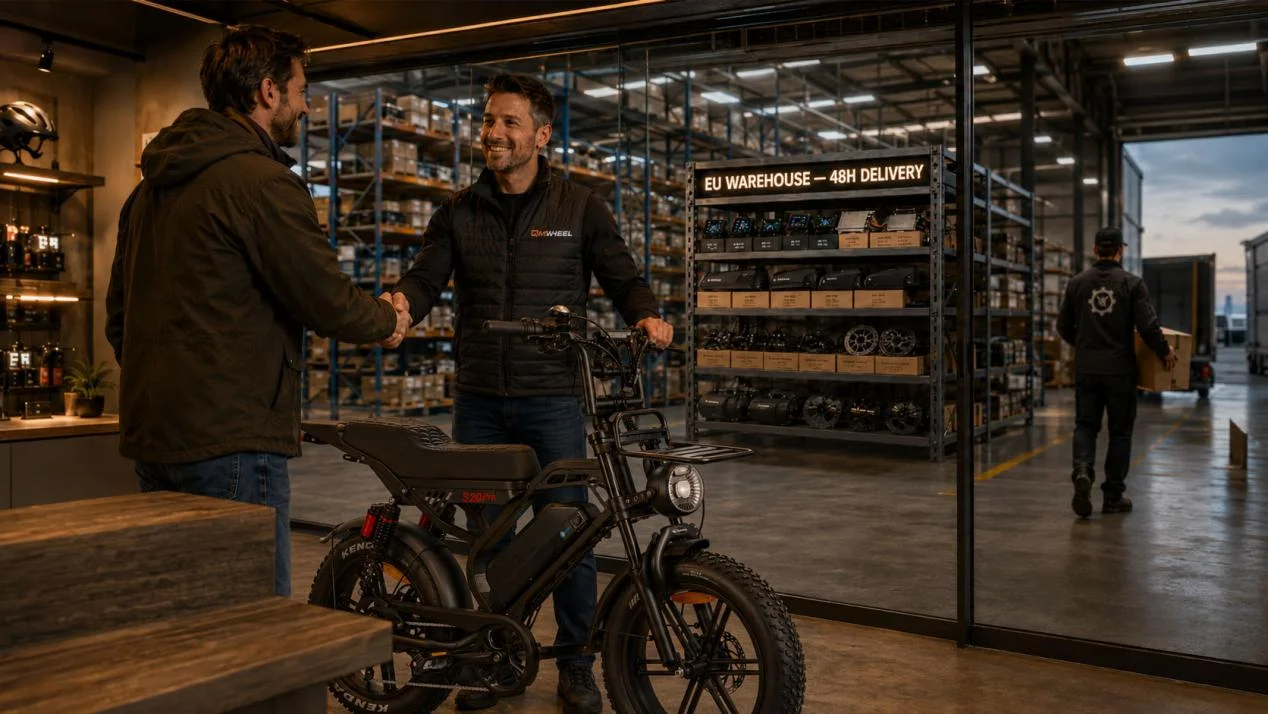
Service Isn't a Promise, It's a Shelf in Our European Warehouse
Read More -
 Blogs
Blogs
Shenzhen Qingmai Bicycle Co., Ltd. and Smartride Supplies B.V. Host Biweekly Tea Gathering
Read More -
 Blogs
Blogs
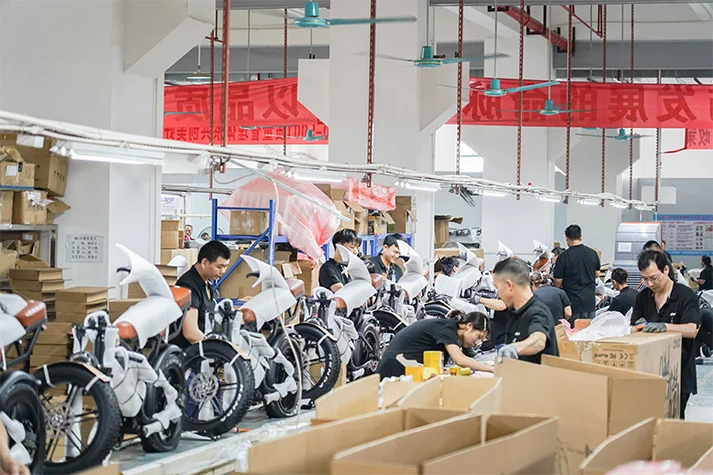
Building Competitive Advantage in the Commuter Fat Tire Electric Bike Market: A Practical Industry Perspective from QMWHEEL Vehicle
The global demand for electric mobility is no longer defined by experimentation—it is defined by operational efficiency, regulatory compliance, and total cost of ownership.
Read More -
 Blogs
Blogs
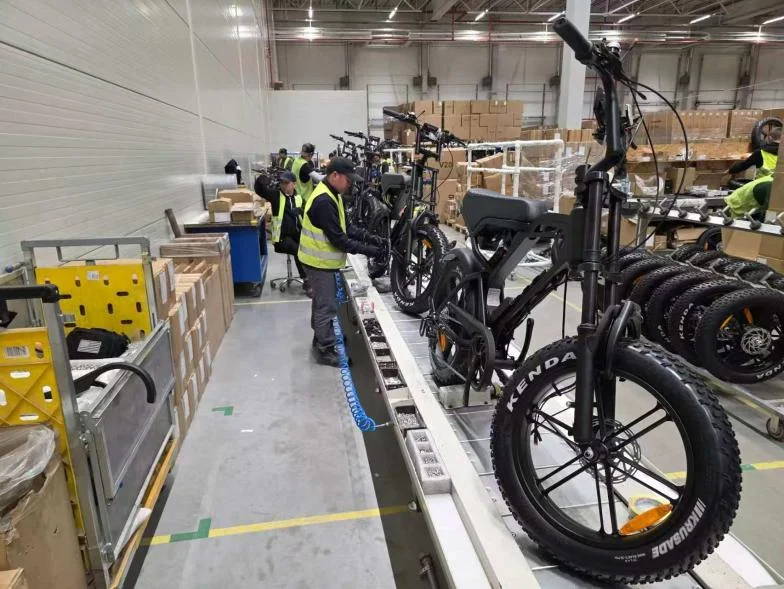
Europe Is More Than a Market, It's Our Second Home Ground
Read More -
 Blogs
Blogs
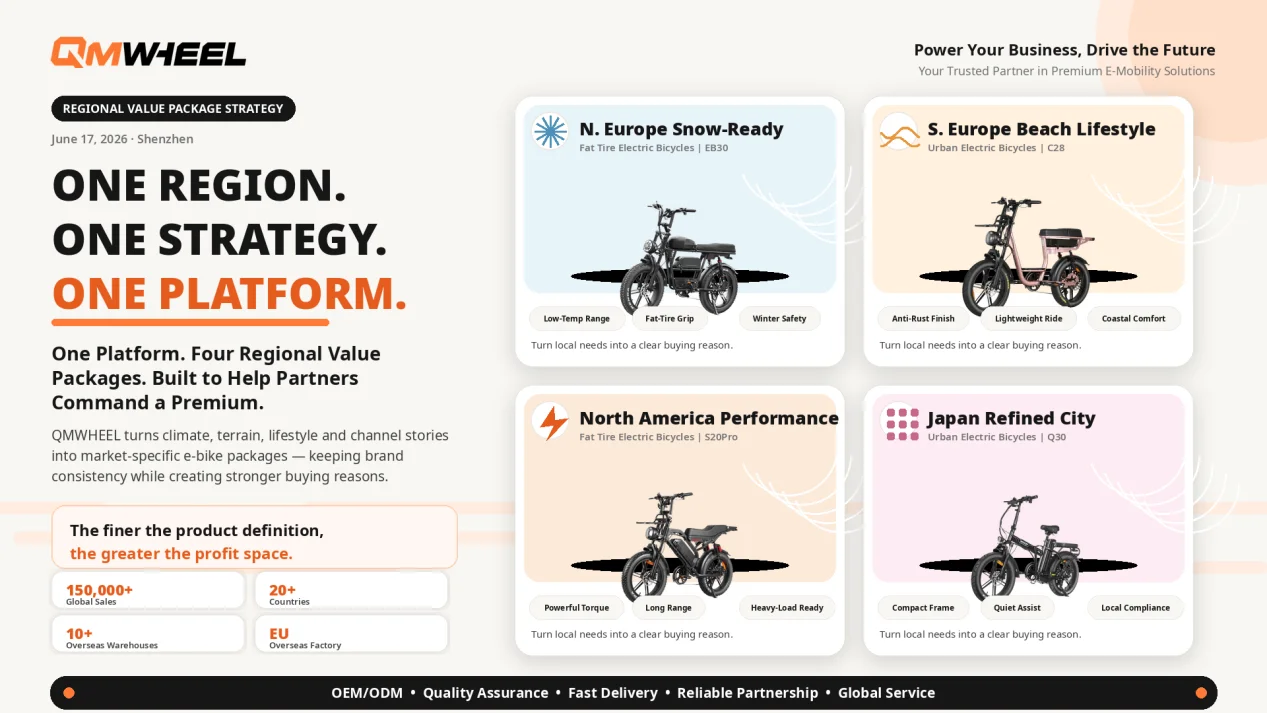
One Platform, Market by Market
Read More -
 Blogs
Blogs
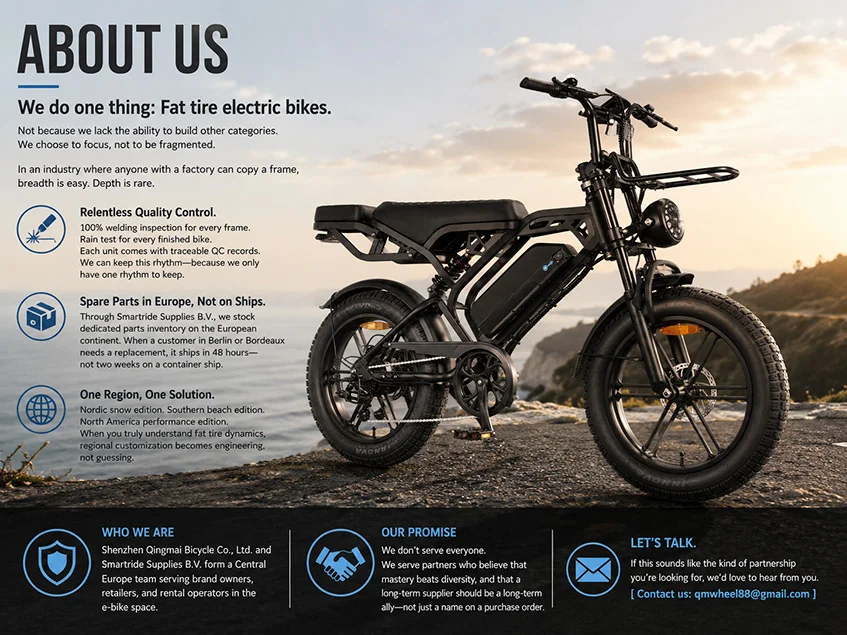
We make one thing: fat-tire electric bikes.
Read More